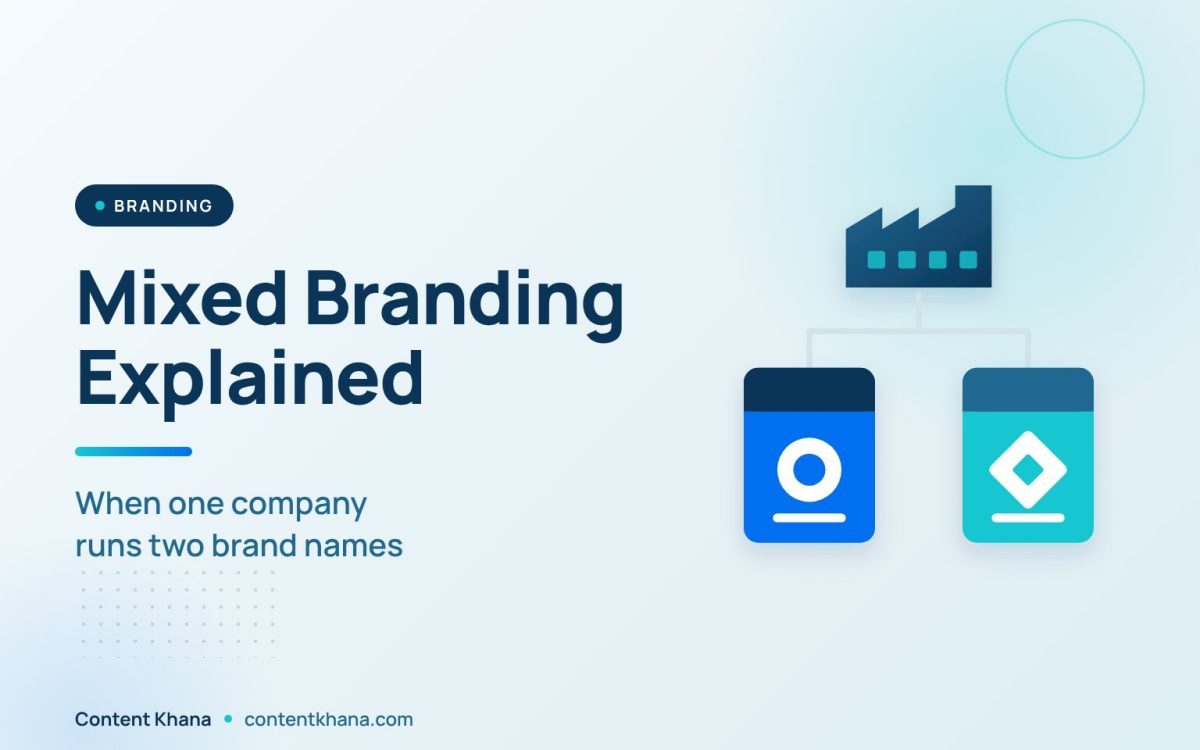
Mixed branding is a strategy in which one company sells products under more than one brand name. In its classic textbook form, a manufacturer sells some products under its own brand and makes others for retailers to sell under the retailer’s label. In wider use, it also describes a company running separate brands for different price points or customer segments, such as a premium brand and a value brand, so that each can be positioned clearly without confusing or damaging the other.
This guide explains how mixed branding works, how it differs from related strategies, real examples, the benefits and risks, and how to decide whether your company should run more than one brand.
What is mixed branding?
Mixed branding usually takes one of two forms:
- Own brand plus private label. A manufacturer sells products under its own name and also produces similar products that a retailer or distributor sells under its own brand. This lets the manufacturer reach price-sensitive buyers and use spare production capacity without discounting its main brand.
- Separate brands for separate segments. A company creates or acquires distinct brands to serve different customers, price levels or channels, for example a premium line and a budget line that look and feel nothing alike.
In both cases, the goal is the same: reach more of the market than one brand could credibly cover on its own.
Mixed branding vs related branding strategies
Mixed branding sits within the wider topic of brand architecture, the way a company organises its brands. Related approaches include:
- Family or umbrella branding (a “branded house”): all products carry the company’s master brand. One reputation, one marketing investment.
- Individual branding or multi-branding (a “house of brands”): each product or line has its own brand, often with little visible link to the parent company.
- Endorsed branding: sub-brands carry their own names with a visible endorsement from the parent, such as “by [company]”.
- Brand extension: using an existing brand name on a new product category.
- Co-branding: two separate companies’ brands appearing together on one product or campaign.
Mixed branding overlaps with multi-branding, but the key idea is a deliberate mix: one company, different brand names, chosen for different commercial reasons.
Mixed branding examples
- Whirlpool and Kenmore. For many years Whirlpool sold appliances under its own name while also manufacturing many appliances sold under Sears’ Kenmore brand, a well-known textbook case of own brand plus private label.
- Toyota and Lexus. Toyota created Lexus as a separate luxury brand rather than asking buyers to pay luxury prices for a Toyota badge.
- Saudia and flyadeal. Saudia Group launched flyadeal as a separate low-cost airline brand, allowing it to compete for budget travellers without changing the positioning of its national carrier.
- Gap, Old Navy and Banana Republic. One company, three clothing brands, each aimed at a different price point and customer.
- Supermarket own brands. Many retailers’ own-label products are made by established manufacturers that also sell their own branded versions on the same shelves.
Why companies use mixed branding
- To reach different segments. One brand rarely appeals equally to premium and value buyers.
- To protect a premium brand. Launching a cheaper line under a separate name avoids pulling the main brand downmarket.
- To manage channel conflict. Different brands can be sold through different channels or retailers without competing directly.
- To use capacity. Manufacturers can keep factories busy by producing for private labels.
- To test new markets. A new brand can try a new category or audience with less risk to the parent’s reputation.
- To contain risk. If one brand faces a crisis, others are less exposed.
The risks of mixed branding
- Higher cost. Every brand needs its own identity, marketing budget, content and management attention.
- Cannibalisation. Brands from the same company can end up taking customers from each other instead of from competitors.
- Confusion. If positioning is unclear, customers, staff and partners may not understand what each brand stands for.
- Dilution. When customers discover that a premium and a budget product come from the same place, perceptions of the premium brand can suffer.
- Split resources. Smaller companies often struggle to build even one strong brand; two can halve the effort behind each.
How to decide whether you need two brand names
Ask these questions:
- Are the audiences genuinely different? Different needs, price expectations or values, not just different ages.
- Would one brand have to compromise its positioning to serve both? If yes, a second brand may be justified.
- Can you afford to build two brands properly? Each needs its own identity, messaging and marketing.
- Should the link to the parent be visible? If the parent’s reputation helps, consider endorsed branding. If it could hurt either brand, keep them separate.
- What happens in five years? Will the brands grow apart, or will you want to merge them later?
These choices belong in your overall plan; see how to write a marketing strategy.
How to manage multiple brands well
- Write a clear positioning for each brand: audience, promise, personality and price level, and make sure they do not overlap.
- Give each brand its own identity system. Logos, colours, typography and tone of voice should be distinct and documented in a brand kit for each.
- Set governance rules: who owns each brand, who approves campaigns, and how shared resources are allocated.
- Decide how the brands appear together, if at all: on the corporate website, in recruitment, in investor communications and in PR.
- Measure each brand separately: awareness, perception and sales per brand, plus any cannibalisation between them.
The corporate brand matters too. Even in a house of brands, people want to know who they work for and who they invest in; our guide to employer branding covers that side.
Mixed branding in the Arab market
Many groups in the region, from family conglomerates to national champions, run several brands across retail, food, hospitality, real estate and services. A few regional considerations:
- The parent’s reputation can be a strong asset. In markets where trust and family names carry weight, an endorsed approach often works better than hiding the connection.
- Arabic and English names both matter. Each brand needs names that work, sound right and can be protected in both languages and in every target market.
- Founders are often brands themselves. For many regional businesses, a visible founder or executive adds credibility across all brands; see personal branding for founders.
Deciding how your brands should fit together? Content Khana’s branding and creative design team helps companies define brand architecture, positioning and identity systems, then builds the guidelines that keep every brand consistent. Book a free consultation.
Frequently asked questions about mixed branding
What is mixed branding in marketing?
Mixed branding is when a company sells products under more than one brand name, for example its own brand alongside a retailer’s private label, or separate brands for premium and value customers.
What is an example of mixed branding?
A classic example is Whirlpool, which sold appliances under its own name while also manufacturing appliances sold under Sears’ Kenmore brand. Toyota and Lexus show a company using a separate brand for a different price segment.
What is the difference between mixed branding and multi-branding?
They overlap. Multi-branding means a company owns several separate brands. Mixed branding emphasises using different brand names, including private labels, to reach different segments or channels.
What are the disadvantages of mixed branding?
Higher marketing costs, the risk of brands competing with each other, customer confusion, and possible damage to a premium brand if its link to a budget brand becomes widely known.
Should a small business use mixed branding?
Usually not at first. Most small businesses are better off building one strong brand before splitting resources across several.
Conclusion
Mixed branding lets one company serve customers that a single brand could not reach without compromising itself. It works when audiences are genuinely different, each brand has a clear role, and the company can afford to build every brand properly. If those conditions are not met, one strong brand is almost always the better investment.
Ready to clarify your brand architecture? Book a meeting with Content Khana or message us on WhatsApp.